
Boycott and Cancel Culture in the Visual Arts
A Conversation Between Augusta Atla and Amelia Jones
October 2026
This article is published in collaboration between AICA Denmark and Art Matter
The article can be read in Danish on the Art Matter website
The conversation forms part of a new series of written dialogues initiated by AICA Denmark, seeking to preserve space for critical thinking within the arts and dialogue among art professionals at a time when the art world itself risks becoming an institution of its own.
Augusta Atla is a Danish visual artist, writer, poet, curator, and cultural critic. She is a board member of AICA Denmark and member of Akademiet.
Amelia Jones is an American art historian, Robert A. Day Professor at USC Roski School of Art and Design, and a leading scholar of feminism, queer theory and identity politics.

The two feminists, the Danish visual artist Augusta Atla and the American art historian Amelia Jones, meet for a conversation about boycotts of visual artists, identity politics and artistic freedom. Across the potential cultural divide between Copenhagen and Los Angeles, the two art professionals share a commitment to upholding the right to disagree without exclusion.
Augusta Atla and Amelia Jones have both long advocated greater diversity of opinion, inclusion and gender equality within the art world. Taking the debate surrounding the Israeli Pavilion at the 2026 Venice Biennale as their starting point, they discuss whether and when cultural boycotts constitute legitimate political action, and whether they can backfire, leading to censorship, social control and political conformity within the art world. At its heart lies a simple question: can two art professionals still speak freely about art theory and politics? This conversation is their shared answer.
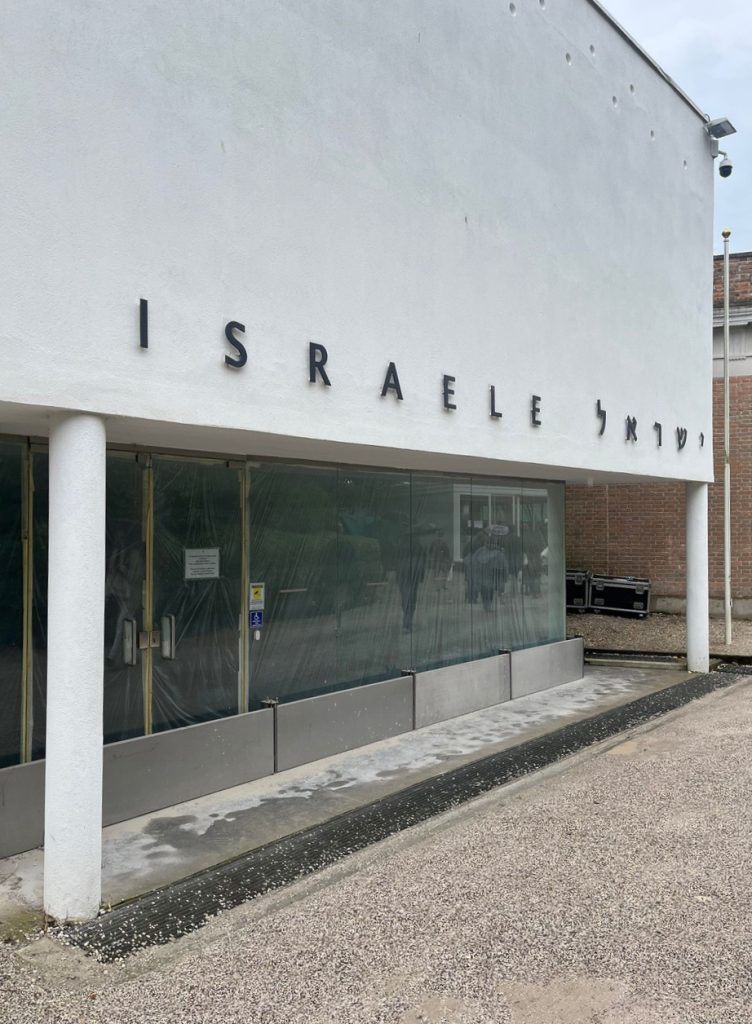
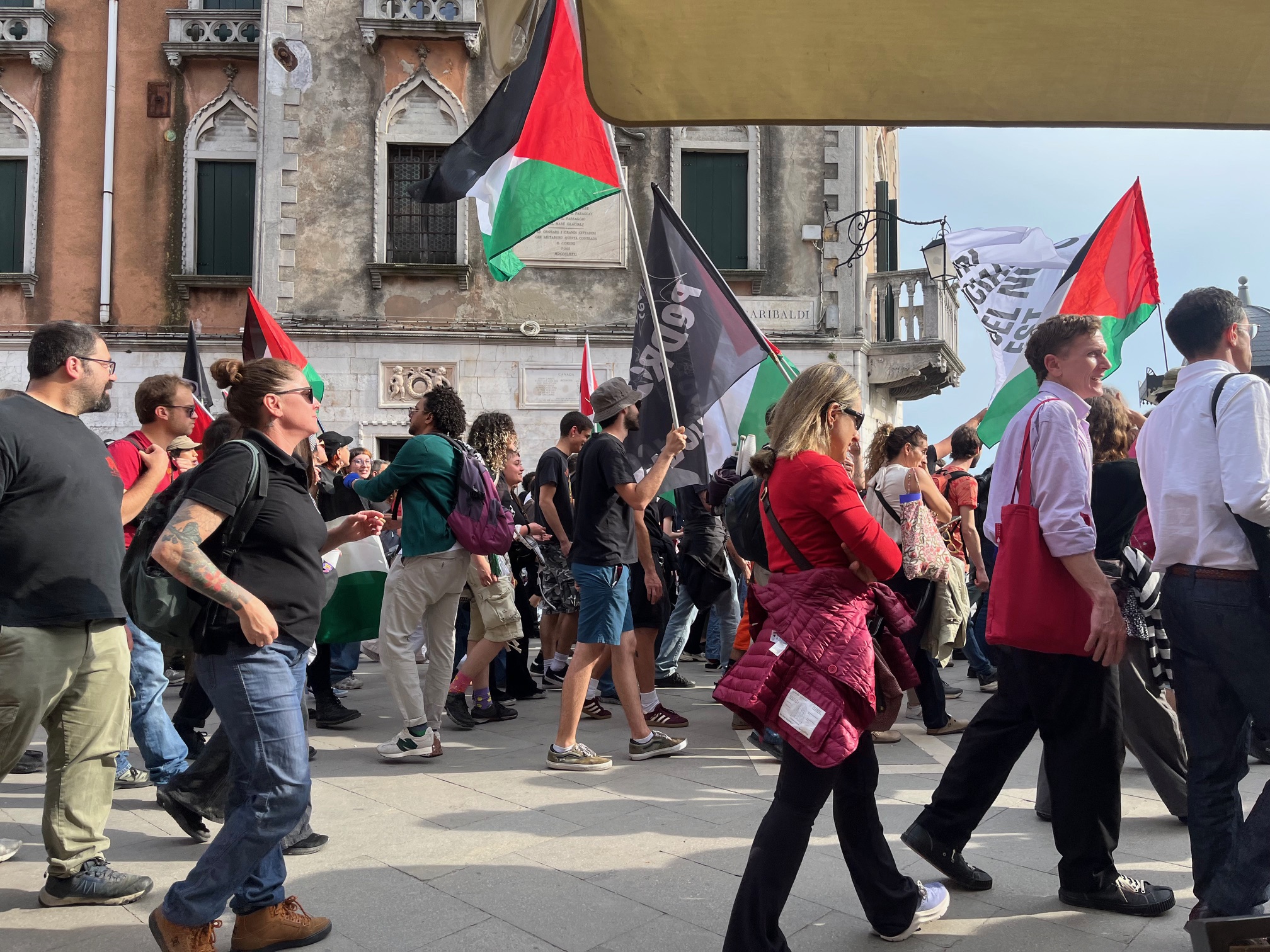
During the opening days of the 61st Venice Biennale in May 2026, more than 15 national pavilions closed fully or partially as part of a 24-hour cultural strike (8 May 2026) organised by the activist group Art Not Genocide Alliance (ANGA) in collaboration with Italian trade unions. The protest was directed against Israel’s participation. At the same time, nearly 200 artists, curators and cultural workers had signed an open letter calling for Israel’s exclusion. The international jury resigned, leading to the cancellation of the Golden Lion awards and the introduction, for the first time in the Biennale’s history, of a public vote — the Visitors’ Lions.
AUGUSTA: At the 2026 Venice Biennale, many artists and cultural workers called for the Israeli pavilion to be boycotted or closed. I know the frame of the Venice Biennale is problematic in the first place, as it is nation-based and very much founded in the Western art canon of colonization and patriarchy. I can support boycotts in sport and business where they exert real pressure, but cultural boycotts are different: they can have an ironically severe counter-effect, since artists are often among a society’s freest, most sensitive and most critical voices. Why silence them?
My objection is to who a national pavilion boycott hits; I believe in the arm’s-length principle: artistic decisions should stay independent of government. A principle is not refuted by being violated; if a state interferes, the answer is to defend the arm’s-length principle, not to punish the artist. Many countries do not have an arm’s-length principle, but that does not automatically mean the artist agrees with their government. I disagree deeply with the Danish right. If it were in power and I were invited to show in the Danish pavilion, I would want to use that room to criticise it, and a boycott would take that room away from me. The worse the government, the more that room matters, as a room of free speech, sensitivity, nuance and for ideas and repressed voices to travel. And if a government’s politics were reason enough to boycott its pavilion, Italy, with its right-wing government, would have to be boycotted too, and with it the Biennale itself.
I was one of the few to enter the Israeli pavilion in Venice during the preview days; it felt really sad. Meanwhile everyone walked into the Chinese pavilion, where there is certainly no artistic freedom. That double standard is what I find hypocritical. It also took the focus away from art as a way to advance human rights overall globally. I want the war in the Middle East to end just as much as you, which is why I care about what actually works. By this I mean that not every artist who exhibits under their state – even in Venice – agrees with their government – on the contrary. Can you understand why I am concerned about these double standards and cultural boycotts?

AMELIA: I wouldn’t start with the boycott in discussing what’s going on in the international art world. I would start with the conditions that cause certain people in the art world to want to boycott the Israeli pavilion: the genocide being perpetrated by the Israeli government. Americans feel so disempowered by our government, which is backing this war, that we are taking opportunities to protest it through boycotts. When it comes to that, of course, art is a part of everything; art institutions are not superstructural to major events but political and economic themselves. I don’t consider culture irrelevant to politics. I consider it the articulation of politics. While I did not go to the Venice Biennale, because I generally avoid big institutionalized events that play on people’s desire for cultural capital, it’s fair game for boycotts because it is inherently structurally implicated in imperialism, capitalism, and nationalism (as you point out). With these cancellations and boycotts, what I would say is that you have to look at every single case and understand exactly why particular people are taking the positions they are taking within institutions. I don’t align with your suggestion that a cultural boycott in itself is wrong, or that it does not achieve effects. I see your point about the Chinese pavilion, but at this point I think the American pavilion might be more obviously worthy of a boycott! In the end, I just don’t generally seek to be part of these glitzy events precisely because they feed on capitalism and the desire for status—they epitomize what I call “cultural capitalism” in my new book (which is called Lifework: Against Cultural Capitalism). Because of the way in which these events play on the desire to be included in seemingly glamorous international events, they encourage the impulse to comply with dark forces such as those of the Israeli or US governments.

AUGUSTA: I deeply understand the urgency of the geopolitical situation right now, and I also wish for peace in the Middle East – without sacrificing either Israel or Palestine. But precisely because of the gravity of the situation, I do not believe that boycotting a national pavilion at the Biennale works as intended. My objection to the boycott within the visual arts does not depend on the legal characterization of the conflict or its historical context. The question remains whether a boycott of a national pavilion is an effective political action, and whom it affects. It also raises the question of whether it is wise to hold individual artists responsible for the actions of a state – and, if so, whether this principle should be applied consistently across all national pavilions at the Biennale. Precisely because the humanitarian situation is so grave, I believe we must critically examine the principles and structures underlying cultural boycotts.
From my experience at the Venice Biennale 2026, we first need to discuss whether the arm’s-length principle exists at all, and whether it ought not to be a minimum requirement for any national pavilion. The arm’s-length principle, which was developed in postwar Britain with the establishment of the Arts Council of Great Britain in 1946, was precisely designed and established to protect artistic decision-making from direct political interference: public funding would be provided, but artistic judgements would remain independent of government.
At this year’s Biennale, however, this principle appeared to be undermined not only by politicians from the outside, but also from within the art world itself – through social pressure, boycotts and the demand for political conformity. Are you not afraid that the art scene is becoming too much of an unnuanced political battlefield – especially when the cause feels urgent?
AMELIA: But the world is a fucking mess—why wouldn’t the art world channel the politics of the world? I would be disturbed if the Venice Biennale showed no signs of the disastrous collapse of Western institutions and our turn towards neofascism. The Trump regime tried to take over the American pavilion—meaning the event is eroded by politics deciding who shows in the national pavilions, and that means it never fully worked in an “arm’s-length” way. The national pavilions have always been manipulated by state and corporate interests—that was the whole point of the original Venice Biennale, which was organized as an opportunity for states to flex their muscle on a “global” stage.
Personally, I would not have gone into the Israeli pavilion, even if I had gone to the Biennale. Fundamentally, I don’t understand why you would start with that argument about why the boycott was staged rather than with the argument that there’s a genocide going on in Palestine. How do we deal with that horror (and, say, the horror of the war the US started in Iran) as artists, or curators, or even just as gallery-goers? That’s the conversation I would start with, and I totally understand the impulse behind people’s desire to boycott the state of Israel. Possibly not the most effective strategy. But maybe it will make a difference—here we are talking about it after all.
Also, I don’t agree that boycotts and other forms of street protest don’t make a difference. I think they make a huge difference. I don’t think they singularly stop wars, but I strongly believe that protesting on the street and staging boycotts are absolutely essential parts of being human together, of fighting injustice, and of conveying messages about where we stand—for example, among other positives, street protests against ICE arrests happening in the US and posted on social media are crucial to alerting the rest of the world that Americans are resisting Trump. Otherwise, the mainstream media that are left make it look like he’s acting with impunity. So I’m saying they make a huge difference, and it makes a difference that there’s a move to cancel the Israeli pavilion, because now we can have this conversation that we wouldn’t otherwise have had. So I consider that a positive.
Another related point here: any artist acceding to having their work represent the US or Israeli government at this moment in time is a problem—I can’t understand why anyone would contribute work to such a pavilion.

AUGUSTA: I agree that the boycott at this year’s Biennale has started this conversation, but I do not believe that cultural boycotts actually work as intended. On the contrary, the desire for exclusion also affects Jewish or Israeli artists at other curated exhibitions around Europe. Unfortunately, I see a tendency whereby legitimate criticism of the Israeli government ends in the suspicion of individual Israeli artists, who are judged by their passport rather than by what they say or create. I know Israeli artists who are openly critical of their own government and took part in demonstrations against it, whose exhibitions have been vandalised in the EU and South America. We know that antisemitism has deep roots in Europe.
AMELIA: I agree that boycotts can backfire, but in this case this boycott would arguably only backfire if people conflate Israel with Jewish people. I feel deeply for my many beloved Jewish friends and colleagues, most of whom have been outspoken critics of Israel and have continually made the point that Israel is not the Jewish people in toto—they are at the forefront of pointing out that antisemitism must not be weaponized by conflating Israel with all Jewish people, such that criticisms of the nation are assumed to be antisemitic.
On the other side, why would you hate an individual Jewish artist who might even be an anti-Zionist? Why would you assume the Israeli pavilion represents all Jewish people and their interests, especially in the face of vocal Jewish groups and individuals speaking out against the Israeli government’s genocide? That makes no sense. That’s where you’re conflating different aspects of identification. And you’re saying, well, this person came from this country, so they must be evil. I mean, that’s absurd.
However, boycotting a national pavilion is very specifically about that nation. It’s not about Jewish people. And that’s where we need to have the debate. In general, we need to absolutely, vehemently, and publicly differentiate individual artists from the state of Israel. Let’s hear what they have to say, let’s let them make their work, let’s deal with their work on its own basis. However, if they choose to align with the Israeli government—which seems to be the case if they provide work for the national pavilion—then we can assume, at the very least, that they are not critical of their government. And hence the boycott of the pavilion would make perfect sense. That’s where I would have that argument, and always with attention to the larger issues and to the history of the Venice Biennale, which was founded out of European nationalism during a time of profound racism in Europe—see Jane Chin Davidson’s book on the treatment of China historically at the Venice Bienniale— Staging Art and Chineseness. It’s fascinating.

AUGUSTA: If one assumes that an Israeli artist exhibiting in the Israeli Pavilion is not critical of their government, one must apply the same assumption consistently to artists in all national pavilions. You do not know this; you are making an assumption. A label based on a passport tells us very little about what an artist believes — and even less about the meaning of an artwork, since the work does not necessarily agree with its creator. Indeed, a work does not even have to be immediately legible. Furthermore, one can be a Zionist while supporting a two-state solution, opposing the current government and wishing for a new, left-wing government in Israel. I know Israeli artists who hold precisely these views.
I am concerned that identity politics, now normalised in the art world, could lead to deeply boring artworks, police opinions and homogenise the art scene. How do you see this tension playing out in the art world today? Are you not concerned that art could become militant? I am left-wing myself, and I support diversity and freedom of religion; I am a feminist and pro-trans. Yet I am concerned that artists are losing their political freedom and that diversity of opinion is no longer permitted in the art world. Or that the artwork is no longer allowed a space of its own, regardless of the artist’s identity and relationship to the work. Perhaps I am not speaking of the ‘autonomy of the artwork’, as the Modernists did, but of the afterlife of the work — a kind of post mortem.
AMELIA: I don’t agree that identity politics are the problem with the art world right now. I’m not saying that there aren’t forces on the left that I find problematic, because there are always disagreements about strategies—and a lot of self examining about so-called cancel culture. I do generally disagree with simple-minded attempts to censor or control—but when you look at an issue in context, it’s rarely as simple as the right-wing attempts to dismiss the left for cancel culture (very common in the US) make it seem. This case of the Israeli pavilion makes that clear, as I hope I elaborated above. There are other specific cases where monitoring or policing how people say things or what they are allowed to say goes so far that it suppresses freedom of speech—but it is clearly the case, at least in the US, that the far right is much more guilty of this kind of extreme suppression. I also don’t think that’s the core of where the problem is here: the ideas of political correctness and cancel culture are the far right’s red herrings to get us to fight among ourselves, to distract us from their policies of demonizing others, silencing liberal or left speech, and attempting to control institutions and speech in general (not to mention their policies of arresting innocent people for not being normative or for having immigrated, their cruelty towards the very families they claim to support, and so on).
On the issue of attempting to control speech, the classroom is a great example. I generally nurture students’ conversations and debates towards the goal of avoiding the policing of behavior in the classroom, which is a parallel for what you’re talking about. For example, while the idea of keeping people of all kinds “safe” in a social space such as the classroom originally might have come from very specific groups of well-meaning, left-wing people, it is a problem (and I would assert that most of my radical queer and trans friends, who are often impacted by violent behaviors in social spaces, agree with me on this). I have said to my students right away at the beginning of almost every class, “this is not a safe space, so don’t ask for it to be a safe space.” And I usually add: “whatever you do, don’t depend on institutions to make you feel safe.” My goal is to give them the opportunity to build their resilience, historical knowledge, and rhetorical abilities—as well as their abilities to form communities of support and care so that they can navigate the world as it is—and it’s not a pretty picture right now!
AUGUSTA: With AI as a tool for art and thinking, my concern is that the artwork is increasingly becoming an instrument for something functional — a “safe space”, as you call it — whether for the state, the Church, the military, nationalism, politics, consumerist aesthetics or capitalism. AI not only creates art that is utilitarian; it also amplifies this utilitarianism by standardising and globalising content. We risk eroding art as a reflective, open space for thinking without answers — and, in the process, transforming the viewer into a convert rather than a thinker. It looks as though we are moving towards anti-humanism at high speed, including in the arts. Isn’t that rather dangerous?
AMELIA: AI is encouraging creative people to give up our creative autonomy to a robot that thinks for us. The advent of AI is a useful teaching tool because it has allowed me to work with the students to highlight what the points of art and creativity are in the first place! When I dialogue with a student (as happened recently) who states proudly to me, “I’m using AI to brainstorm!” I ask them: “why would you allow a set of algorithms to scrape previous creative expressions to give you ideas? Why give your originality away to the tech companies and their fundamentally racist and problematic algorithms?” AI as a supposedly creative tool confuses what, I would insist, creativity actually is. You cannot separate someone’s expression from what it is they’re expressing. Duchamp’s conceptually driven readymades in the 1910s already started teaching audiences that if you make a work from a conceptual point of view, it still ends up being about you. That was, in a way, the whole point his readymades ended up making—he clearly found it amusing to then make replicas of the readymades in the 1960s, which had great art market value because they were seen as “masterpieces” by him, identified as a “genius.” But with AI, you know, my question is, why would we even want to look at something that doesn’t tell us anything? All an AI output tells us is that the algorithm amalgamated a lot of other peoples’ works. Are we interested in the algorithm? My guess is probably not. Does it have a creative vision that could be inspiring? No. The whole point of an artwork of any kind is to connect people—even when we are repulsed or filled with feelings or desires we don’t like in encountering it, we find it compelling because we interpret it as human output. (This is aside from AI-induced psychosis—and we are only now starting to see what happens to people who confuse the chatbots, which notoriously over-praise and inflate the ego of the user, with actual human output.) Our whole desire to make art and see art has to do with being human and connecting with other humans.
AUGUSTA: I agree that art is never neutral. But that is not the same as turning the whole art scene at the luxurious Venice Biennale into a battlefield for banners and class conflict. Precisely because the suffering is real, the whole thing appeared even more hypocritical.
AMELIA: It’s not the pro-Palestine politics that are a problem, it’s the hypocrisy of anyone involved in the art world putting these politics forward in that setting where they are bound to seem compromised or hypocritical. And this is why these micro scandals where you’re trying to cancel the Israeli pavilion, in a way, could miss the point. I agree with the impulse because I believe in boycotts and protesting, but I also think, if you’re going to protest the connection of money and nation states to genocidal actions in Palestine/Israel, just refuse to go to the Venice Biennale. If everybody just boycotted it and we returned to more intimate ways of making and sharing art—that would be a statement.
AUGUSTA: I fought the blasphemy law here in Denmark, firstly because I have made feminist works with the Bible myself since 2012, and also because I love and admire the work of Pier Paolo Pasolini, Sergei Parajanov and John Latham. I deeply wish to protect their legacy. Furthermore, I respect the artists who fight the secular feminist struggle, ‘Women, Life, Freedom,’ through their art—for instance, the Danish-Iranian artist Firoozeh Bazrafkan.

AMELIA: From my brief readings about this in your work, I would probably completely agree that a blasphemy law is a stupid idea, precisely because these things are situational. You have to look at every single situation separately. The burning of the American flag has been a huge red button issue in the US through every culture war since the 1980s for similar reasons. But many on the right as well as on the left understand that a flag burning is not necessarily “disrespectful”—it’s often the deep thinkers who care the most about a place who will take up such an action.
AUGUSTA: Art has historically been able to cross borders, criticize power, transgress norms and refuse national identities. Is the role of the artist as an exile, an intellectual or a politically engaged person lost today? How do we keep fighting for human rights within the arts when the art scene — and perhaps even the people inside it — begins to become an institution of its own?
AMELIA: In my book, Lifework: Against Cultural Capitalism (which should be out in 2027 from Intellect Press), one of my arguments there is that the reason it’s worth looking very carefully at the art world and the university is that these two sets of institutions represent the biggest gap between what the constituents, the workers, students, public, and contributors—think we’re doing, and what the institutions are actually doing (usually focusing on income flows, branding, national or corporate identity-building). And I would say that would absolutely apply to the Venice Biennale, just as it would apply to the Whitney Museum, which is constantly caught up in scandals because of the gap between who is funding it and the radical positions of many of the artists and some curators involved. This book is kind of a manifesto about the toxicity of these institutions and how we can continue to make, teach, write, and think without succumbing to this toxicity. That’s half of the book, and then the other half of the book is the sections on lifework, which is my term for describing and foregrounding how creative people, including curators, artists, and scholars of a certain kind, can work in ways against the grain of those imperatives pushing us towards cultural capitalism through political forces, whether it’s neoliberalism or neofascism. I make the point that it is absolutely possible to survive and thrive in spite of the negative institutional pressures we are all facing, and I have all these very specific examples of people I admire in the book. Most of them are not wealthy, because you do not become wealthy by avoiding these institutional imperatives, but they have rich creative lives with many friends who support them.
AUGUSTA: In In my opinion, the artist and the human being are transnational. By this, I mean that the state is never fully representative of an individual’s political values – even in a well-functioning Scandinavian democracy, and certainly not under a regime or in a corrupt or fascist state. As a descendant of a family from the resistance movement, it is deeply ingrained in me, through generational trauma, that the persecution of Jews in Europe must be remembered in its own right, rather than turned into a simplistic analogy for present-day conflicts, and that a person cannot be reduced to the state or regime they happen to live under. After 1945, Europe lay in ruins—both physically and morally. Timothy Garton Ash, in his book Homelands: A Personal History of Europe, describes how the continent slowly rose from the hell of war. It was precisely in this context that the arm’s-length principle was created — to ensure that art would never again become an instrument of power.
I see art as a humanist zone that is precisely non-nationalist; almost like a shared zone of exile. Although I am not a nationalist myself—I rather prefer a strong and united EU—I still find the Venice Biennale legitimate in the sense that it is capable of bridging dialogue between artists globally and allowing ideas to travel transnationally. For that same reason, I would regret to see it vanish, even if its current nationalist structure is deeply outdated.
And it is profoundly ironic that excluding countries without artistic freedom would, once again, reduce the Biennale to an elitist platform solely for privileged democracies—entirely contrary to all postcolonial intentions. For the future, I see the Biennale as an exchange of ideas between artists – the free thinkers of the world. If I were ever to be the chief curator of the Biennale, I would ask all countries to swap pavilions and host each other, so that no nation would occupy its usual pavilion.
How do you view the possibilities for art to function as a space that is precisely non-nationalist, and what should we do about the Venice Biennale from that perspective?
AMELIA: I mean, you can’t maintain the Venice Biennale which is structurally nationalist and neocolonialist and act as if it’s a neutral zone of artistic excellence. It’s a problem. I engage every student who goes through my classrooms [at the Roski School of Art and Design at University of Southern California] in these conversations such that they can’t think of themselves unproblematically as freely creative people who just produce art outside of cultural, political, economic, and social conditions—we are all informed and shaped by these. The Venice Biennale is structurally racist (privileging European modes of artistic production and display), so how are you going to solve that problem? The core problem is with the institutions, not with individual artists per se, because the institutions are rotten. They’re completely rotten. And the so-called leadership is, at best, weak and, at worst, sycophantic with the very dark forces of corporatism, a renewed white nationalism, and capitalism today.
AUGUSTA: The Berlin Wall fell in 1989, yet sometimes it still feels present in the art world — as if the artist must choose between two camps: either the artwork as propaganda in the service of class struggle, or the Western liberal idea of art as non-functional, where the very act of free interpretation becomes democracy in action. At the same time, we know that this liberal model was also instrumentalized during the Cold War—for instance, by the CIA, through Abstract Expressionism. What if an artist simply insists on the freedom of art above both of these frameworks? Is that still possible, or is the concept of art doomed to remain trapped inside a permanent Cold War logic?
AMELIA: No it’s never been possible. The entire concept of autonomous art has been shown over and over again to have been deeply political from its inception in nineteenth-century Europe (as you point out, the US government was using Abstract Expressionism—which was heavily marketed by art critics, curators, and the artists as “autonomous” from the political realm—to market American-style “democracy” (arguably actually capitalism not democracy per se). Artists are like everyone else—they live fully in the world. Therefore nothing they do will or can be separate or autonomous from social and cultural systems, themselves inseparable from political and economic ones. Policing expression to keep spaces supposedly neutral or safe—as I argue above—is a terrible idea.
That said, I think we both agree that freedom of speech is never full or perfect, but it’s a crucial ideal to stave off forms of neofascism, as we are learning today in the US and elsewhere. As Immanuel Kant said over two hundred years ago, we have to act “as if” freedom of expression exists and is encapsulated in something we call art—this is Kant’s aesthetic reduced to one core idea. If we give up this agreement, we will need something new to replace it or the (neo)fascists will find something new for us (state-controlled kitsch, if Hitler and Trump are examples!).
But I’ve pointed out that your example of the boycotting of the Israeli pavilion is really not cancel culture. Boycotting is a political act. It’s a way of refusing complicity in a highly problematic cultural space.
AUGUSTA: I agree that a boycott is a political act; my question is whom it hits. And I agree that art is never autonomous in the sense of standing outside the world. I understand the argument from identity politics that artwork and artist can never be fully separated, and that the politics around us shape how we make and experience art. I do not deny that. What I defend is not the autonomy of the artwork but the zone of art: a freedom that in its essence cannot be made a function of the state or of any specific cause, because freedom is transgressive by nature.
But even when politicians instrumentalize art—and even frame it in Cold War terms—they still cannot take away the inner freedom of the artist or the viewer. They can only lull us into forgetting that freedom, and human rights with it, which is why we must keep fighting to remember it.
I take identity politics seriously, and I want to go a step further with Kierkegaard: ‘The self is a relation that relates itself to its own self.’* The self also relates to itself, and within that relation a distance opens up. This distance is the zone of art: a space of its own where both artist and viewer remain reflective without denying their identity. It is precisely for this reason that the outer conditions protecting it—such as the arm’s-length principle—are so important.
For me, the best artworks are those I can never fully explain, no matter how many times I return to them. The viewer’s free interpretation of the artwork is, to me, the essence of art. For example, I love Nabokov’s Lolita—a work so difficult that we can no longer equate the artist with the artwork. I am not saying that I value or prefer these works over, for instance, the works of Nan Goldin; I love her art too. I just hope there is still room for a Nabokov today.
I love artworks that make strong political claims and are closely aligned with the artist’s identity and politics—even artworks that set out to preach, to riot or to convert—but there must be room for a Nabokov today. Fundamentally, I am arguing for an inclusive pluralism in the arts by protecting this zone of art. If we do not, we lose both the complexity of the artwork—its capacity to remain ambiguous, open, to open up sensibility and not necessarily be ‘readable’—and the freedom of the viewer and of art itself.
AMELIA: We in Europe and the US have taken artistic freedom, like freedom of speech in general, or academic freedom for granted; we’re now learning how complicated they are, because, you know, it’s never a totally open field on which we are operating. So that means it’s a very complicated conversation. It’s not just that anyone should be allowed to say anything at any time—this has never been the case. All sides of the political spectrum have made cases for censoring or prohibiting certain kinds of speech at various times. These freedoms are also unfortunately very tenuous.
I guess my final argument would be we need to keep the doors open to constantly talk about what we agree should be allowed and embraced, and what we decide should not, because otherwise the system becomes rigid and fascist. We have to take care of each other. I have come to believe that art (of any kind) is fundamentally a social thing—a work of art and all of the joys, pleasures, criticisms, and institutions around it, whether it’s a concept or a painting, or a performance, brings us into a space of productive collective engagement and conversation.
AUGUSTA: If the most “correct” work of art becomes the measurement of value, do we not risk ending up with social control instead of critical thinking?
AMELIA: My whole point was against this kind of simplistic cancel culture that you keep evoking. But I do not think the boycotting of the Israeli pavilion is “social control”—it’s a protest, and everyone has the right to protest as long as they don’t hurt others in doing so. That said, as a feminist, I have long made exactly the point you’re making, which is that, ideally, we should not, as feminists, be legislating what is feminist, or what is “good” or “bad” feminism (see my 1996 Sexual Politics catalogue on this point). We can certainly have very productive debates about what feminist works we feel are powerful or progressive and which are not—but legislating, as so many of the British and New York feminists were doing in the 1970s into the 1980s (albeit for good reason, but that’s another story), is ultimately counterproductive to what I believe the aims of feminism are (among other things, avoiding authoritarian proclamations of what is right or wrong as a cultural formation).
AUGUSTA: I just hope that a work like Nabokov’s today would not be banned, just as I wish for Sally Mann’s and Kara Walker’s work never to be banned. It is healthy for us, as viewers, to be confronted with difficult artworks, they teach us to think and have a mind of our own. I fight for the afterlife of the work and its right to exist, no matter how difficult the content is—and I am left-wing! I love looking at and reading works I politically disagree with, such as the poems of Yeats. They force me to think, perhaps also to distance myself, and to remain in that complex position of loving the work while disagreeing with the artist’s political views. I would hate to only see art that I politically agree with. It would remind me of a kind of neo-Soviet condition—the very thing Kandinsky fled from.
AMELIA: Well we can agree on this point—the legislation of value, or (even worse) of what is allowed to be exhibited or read and what is not, generally opens the door to fascism or neofascism (or is a result of that door already having been opened).I would point out that, while the far right in the US is perennially trying to censor books like Lolita, and even more often feminist or queer classics, one can still easily access the book online in the US—it has not been disappeared! I know in some countries that may not be the case. What concerns me is that the creative people I hang out with are being persecuted with increasingly open hatred and violence in and beyond the USA—those who make very little money in the art marketplace, but whose lifework inspires by showing how to live creatively without complying with the neofascisms of corporate, national, and—yes—“global art” forces, such as the Venice Biennale. This parallels the hatefulness with which the Israeli government, with US support, is attacking Palestinian civilians. For more on those examples of lifework, read my forthcoming book Lifework! It should be out in 6-9 months I hope.

“Although Amelia Jones and I clearly do not share the same positions on several of the central questions discussed here — particularly regarding cultural boycotts, Zionism and the role of political framing in the art world — I am grateful for the openness of this exchange. I would welcome the possibility of continuing our conversation at a later stage, in order to explore these complex issues in greater depth.”